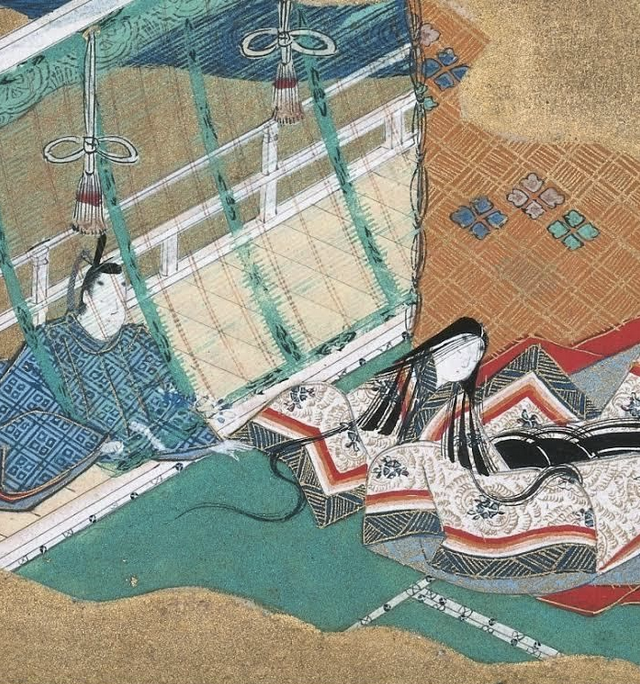
Sei Shonagon
(c. 966 – c. 1025)
Japanese author of the Pillow Book (枕草子)
“Someone who butts in when you’re talking and smugly provides the ending herself. Indeed anyone who butts in, be they child or adult, is most infuriating.”
Sei Shōnagon, The Pillow Book
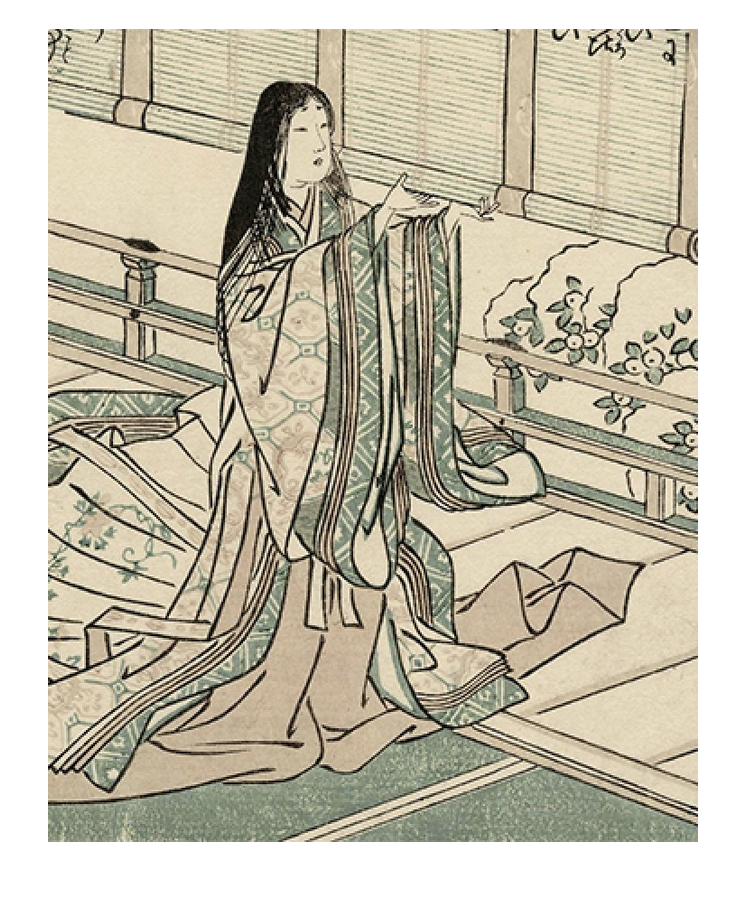
During the Japanese Heian period, (794 to 1185), women were discouraged from learning how to read and write and instead were directed towards lesser system known as Kana. This simplified and less sophisticated language model restricted women from be able to do full calligraphy and have an in-depth knowledge of the language.
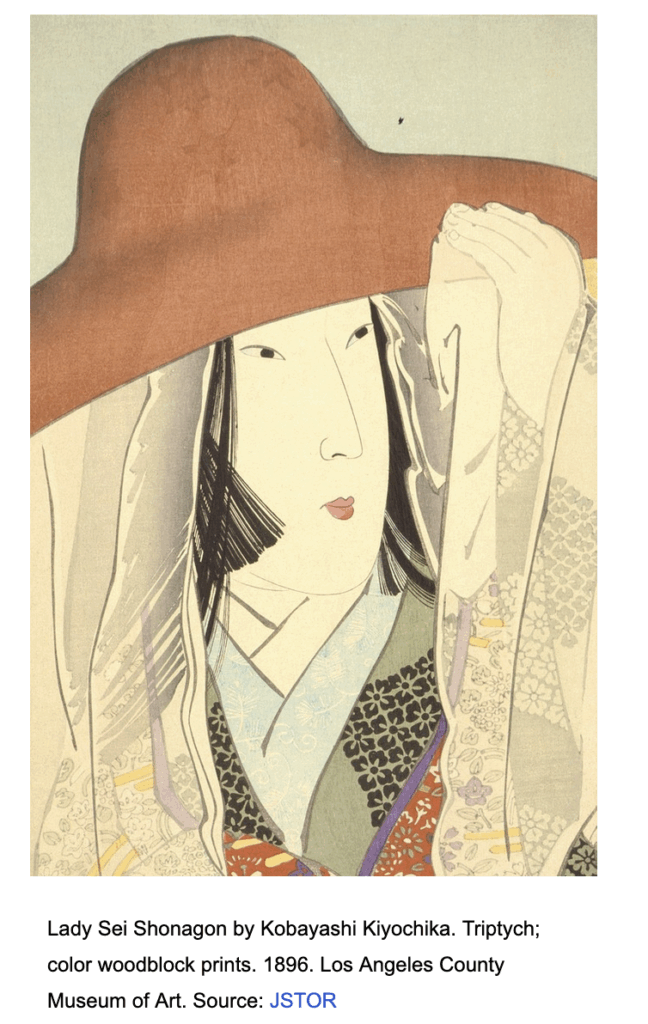
Sei Shōnagon broke through this barrier to write The Pillow Book (枕草子) a masterpiece of Japanese classical literature. Written during her time serving as a lady in waiting to Empress Sadako (also known as Teishi), it’s part diary, part poetry, part essay and part continuous narrative. The author’s real name is unknown and Sei Shōnagon translates to “minor councillor of the state.” (It was a common practice to call someone after their function in court. Although scholars are considering she may Kiyohara no Nagiko (清原 諾子).[1]
Shōnagon’s Pillow Book (枕草子)has over 300 entries of personal narratives, prose poetry, descriptions of nature, anecdotes of characters, witty observations and vignettes of court
The book name itself refers to private and informal journals containing thoughts and observations composed while alone. These books were usually stored in small drawers built into wooden pillows.[2]
Her access to the Empress Tiesha, allowed Shōnagon to record court life in writing infused with smart and witty observations. A remarkable feat considering she was discouraged from being fully literate due to her gender. And while The Pillow Book (枕草子) is a historical document, Shōnagon’s writing still speaks to us today.
QUOTES
“In life there are two things which are dependable. The pleasures of the flesh and the pleasures of literature.”
“A man who has nothing in particular to recommend him discusses all sorts of subjects at random as if he knew everything.”
“Sometimes a person who is utterly devoid of charm will try to create a good impression by using very elegant language; yet he only succeeds in being ridiculous.”
“A pair of silver tweezers that can actually pull out hairs properly.”
“You never find an instance of two people living together who continue to be overawed by each other’s excellence and always treat each other with scrupulous care and respect, so such a relationship is obviously a great rarity.”
Rare Things:“A son-in-law who’s praised by his wife’s father. Likewise, a wife who’s loved by her mother-in-law.”
[1] https://en.wikipedia.org/wiki/Sei_Sh/ Katō, Bansai [in Japanese] (1674). 清少納言枕草紙抄 (in Japanese).
[2] https://libraryguides.bennington.edu/courtly/shonagon
Read more
https://libraryguides.bennington.edu/courtly/shonagon
https://www.goodreads.com/author/quotes/10983.Sei_Sh_nagon
https://en.wikipedia.org/wiki/Sei_Sh%C5%8Dnagon
https://www.laphamsquarterly.org/contributors/sei-shonagon
· Keene, Donald (1999) [1993]. A History of Japanese Literature, Vol. 1: Seeds in the Heart – Japanese Literature from Earliest Times to the Late Sixteenth Century (paperback ed.). New York, NY: Columbia University Press. ISBN 978-0-231-11441-7.
· Donawerth, Jane (2002). Rhetorical Theory by Women Before 1900. Lanham, Maryland: Rowman & Littlefield. ISBN 978-0-7425-1716-5.
· Sato, Hiroaki (1995). Legends of the Samurai. Overlook Duckworth. ISBN 9781590207307.
· Tsunoda Bun’ei 1975. “Sei Shōnagon no Shōgai” in Makura Sōshi Kōza, Vol. 1. Tokyo: Yūseidō.
· Sei Shōnagon (2006). The Pillow Book. Translated by Meredith McKinney. London, England: Penguin Books, Ltd. ISBN 0-140-44806-3.